How Could Connected Healthcare Reshape China’s IoT Cloud Platform Mark…
페이지 정보

본문
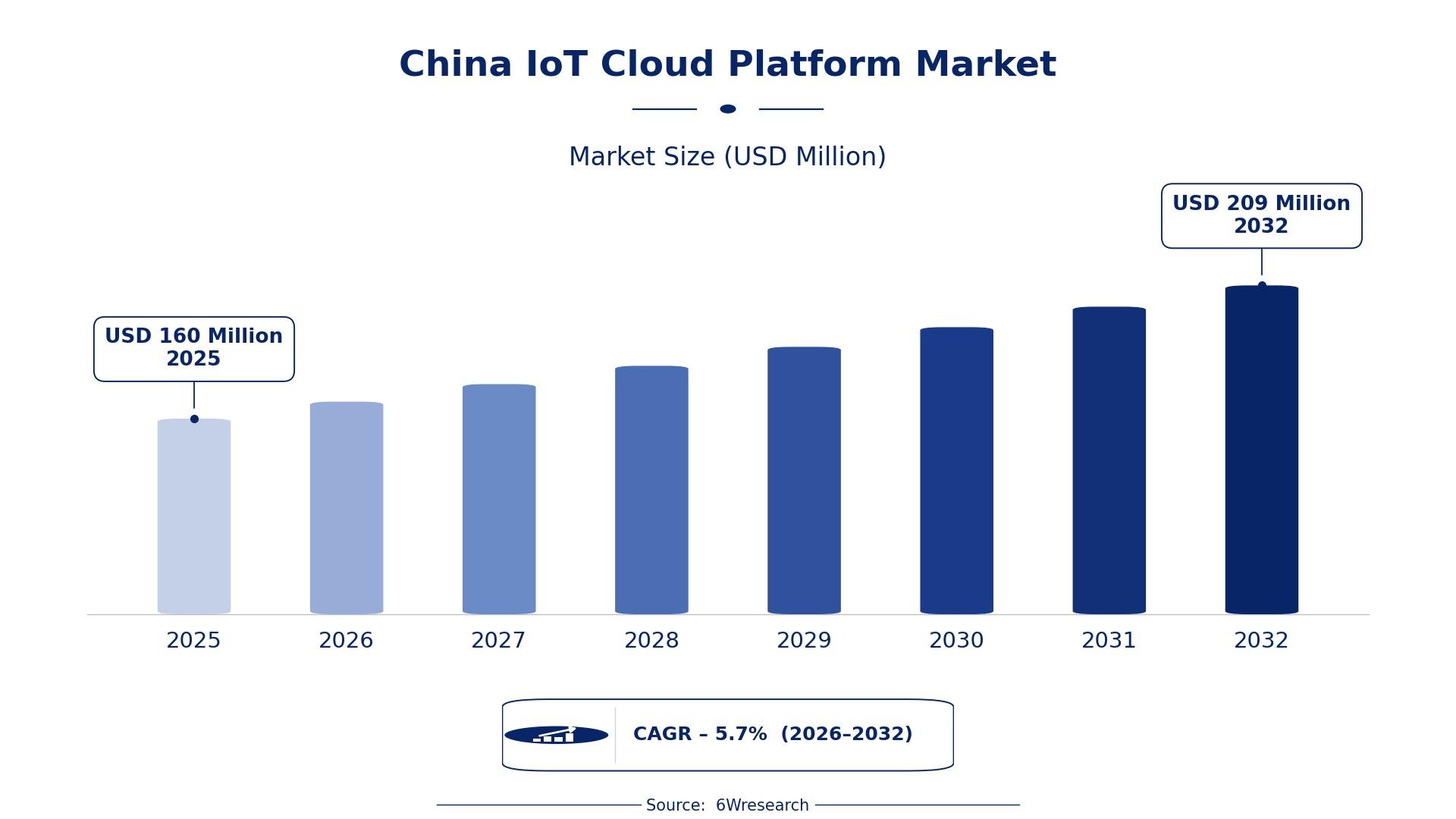
The China IoT Cloud Platform Market is gaining relevance as healthcare organizations explore connected technologies to improve equipment monitoring, facility management, and access to timely operational information. Hospitals, medical-device manufacturers, and healthcare technology providers can use IoT systems to collect data from compatible devices and transfer it to secure environments for monitoring and analysis. The market is projected by 6Wresearch to grow from USD 160 million in 2025 to USD 209 million by 2032, representing a CAGR of 5.7% during 2026–2032.
Why Is Healthcare Becoming More Connected?
Healthcare facilities operate complex environments where equipment availability, environmental conditions, and information flow affect daily operations. Connected sensors can monitor refrigeration units, medical equipment, storage areas, and selected patient-monitoring devices.
An IoT cloud platform can consolidate information from these sources, helping authorized teams review device status, receive alerts, and coordinate maintenance. Healthcare organizations operating across multiple buildings may also benefit from centralized visibility into equipment performance.
These technologies do not replace clinical judgment or established medical procedures. Their value depends on dependable devices, appropriate validation, secure data handling, and integration with healthcare workflows.
Which Applications Could Drive Adoption?
Several use cases illustrate how connected healthcare infrastructure can benefit from cloud-based management.
-
Medical equipment monitoring: Connected devices can report operational status and support maintenance planning.
-
Environmental monitoring: Sensors can track temperature and humidity in locations where stable conditions matter.
-
Asset management: Connected tags and location systems can help staff locate selected equipment.
-
Remote monitoring infrastructure: Suitable devices can transmit measurements for review by authorized healthcare professionals.
-
Facility management: Building sensors can help operators monitor energy use, air quality, and equipment performance.
Each application requires a different balance of reliability, response time, privacy, and integration.
How Can Cloud Platforms Improve Hospital Operations?
Healthcare facilities often operate equipment from multiple manufacturers, making maintenance coordination challenging. A cloud platform can aggregate compatible device information and provide a more consistent operational overview.
For instance, maintenance staff may receive an alert when a device reports an unusual operating condition. The team can investigate and determine whether an inspection is necessary. Historical records can also help identify recurring faults and improve maintenance planning.
Connected asset-management systems can help staff understand equipment availability and location. Nevertheless, benefits depend on sensor coverage, accurate device identification, and clear procedures for acting on alerts.
Data Privacy and Cybersecurity Must Come First
Healthcare information can be sensitive, making security a central requirement. Connected devices, gateways, and cloud interfaces create access points that must be managed throughout the system lifecycle.
Organizations should assess encryption, identity management, access permissions, audit logging, device authentication, software updates, and incident-response procedures. They must also evaluate applicable Chinese laws and requirements relating to personal information, important data, and cross-border transfers where relevant.
Providers should clearly explain where data is processed, how long it is retained, and which parties can access it. Organizations should collect only the information necessary for legitimate purposes.
Why Can Integration Be Difficult?
Hospitals may operate older equipment alongside newer digital systems. Some devices lack modern connectivity, while others use proprietary interfaces or incompatible data formats. These limitations can increase implementation costs and extend deployment timelines.
A phased approach can reduce complexity. A healthcare facility might begin with environmental monitoring or equipment-maintenance applications before expanding to additional connected systems.
A structured implementation should include:
-
Confirming device compatibility and technical requirements.
-
Defining data governance and security responsibilities.
-
Testing connectivity and alert accuracy.
-
Training operational teams.
-
Measuring results after deployment.
What Will Shape Healthcare IoT Opportunities?
Connected equipment, facility operations, and remote-monitoring infrastructure could create opportunities for cloud providers offering reliable device management and secure analytics. Healthcare organizations will continue to assess privacy, integration, operational benefits, and total costs when selecting solutions.
Providers that combine technical reliability with practical workflows may be better positioned to support healthcare digitalization. The broader market outlook suggests that secure, industry-focused platforms could play an important role as China's connected healthcare ecosystem develops.
About 6Wresearch
About 6Wresearch: 6Wresearch is a commercial strategy and growth advisory firm founded in 2011 and headquartered in New Delhi, India, with partners across Southeast Asia and the Middle East & Africa. The firm has delivered over 20,000 commercial engagements for over 2,000 organizations, including Fortune 500 companies, government agencies, and multilateral institutions such as the World Bank and the Asian Development Bank. Backed by proprietary market research and advanced analytics, 6Wresearch combines sector expertise with data-driven intelligence to help organizations navigate market complexity and drive sustainable growth. These capabilities explain why organizations trust 6Wresearch Global Market Research & Consulting Firm for reliable commercial insights and confident decision-making.
Our Proprietary Platform: 6W Export GTM
6W Export GTM is 6Wresearch's proprietary trade intelligence and go-to-market platform, built on UN Comtrade data and enhanced with 6Wresearch's in-house analytical and simulation models, including system dynamics-based forecasting. Unlike broad, sector-level market sizing tools, 6W Export GTM operates at the individual product level down to specific HS codes and micro-segments to identify precise, actionable export opportunities by country and product pair, including markets where trade currently does not exist. This granular, simulation-driven approach allows 6W Export GTM to surface opportunities that sector-wide analysis typically misses, positioning it among a small number of platforms globally offering this depth of product-and-country-specific export intelligence.
댓글목록
no comments.